A single traditional chemistry laboratory setup costs UK schools £25,000-£70,000 for initial equipment, with ongoing annual costs of £5,000-15,000 for consumables, maintenance, and safety compliance (CLEAPSS, 2024). A single fume cupboard alone costs £6,000-£8,300, while class sets of quality microscopes can exceed £5,000 (SLS Education, 2025). For under-resourced schools, these costs are prohibitive, and the situation is worsening. According to EngineeringUK research, 27% of UK science teachers report their schools cannot afford the equipment needed for practical lessons, while 26% say they simply don't have enough equipment (EngineeringUK, 2024). WhimsyLabs offers a transformative alternative: unlimited virtual laboratory access at a fraction of traditional costs. Critically, as an impact-focused company rather than a profit-driven company, our mission is democratizing STEM education worldwide, not maximizing shareholder returns. This comprehensive cost-benefit analysis demonstrates how virtual laboratories deliver superior educational and financial outcomes while advancing educational equity.
"When we analysed the return on investment for schools adopting WhimsyLabs, the numbers were striking: a typical secondary school spends £15,000-£25,000 annually on science lab consumables alone. Chemicals, broken glassware, disposable materials are just a small aprt of the ongoing costs of running a lab. Our platform eliminates those recurring costs entirely while enabling unlimited experimentation. But ROI isn't just financial. Schools using our virtual labs report students completing 3-5× more experiments per term than they could physically afford. That's the real return: transforming budget constraints into unlimited learning opportunities."
Dr. Marisa French, Founder & CEO, WhimsyLabs
What Are the True Costs of Traditional Physical Laboratories?
The financial burden of physical laboratories extends far beyond initial equipment purchases. Schools must consider capital costs (laboratory furniture, fume hoods, safety equipment, glassware, specialized instruments), consumable expenses (chemicals, reagents, disposable materials, replacement glassware), operational costs (utilities, water, specialized ventilation, waste disposal), maintenance expenses (equipment calibration, repairs, replacement of broken items), staffing requirements (laboratory technicians, safety officers, additional preparation time for teachers), and compliance costs (safety training, chemical storage regulations, waste disposal permits, insurance). According to Department for Education data, science laboratory equipment typically requires a 5-10 year replacement cycle, with annual maintenance costs running 5-8% of total equipment value (STEM Learning).
Beyond direct financial costs, physical laboratories impose significant hidden costs. Limited equipment availability restricts practical work to scheduled times, preventing flexible learning and individual practice. Safety concerns eliminate certain valuable experiments entirely, particularly those involving dangerous reagents or volatile reactions. Equipment breakage and consumable depletion mean experiments must be rationed rather than offered freely. Teacher preparation time, typically 1-2 hours per hour of instruction, represents substantial opportunity cost.
The UK's Practical Science Crisis: By the Numbers
The state of practical science education in the UK has reached crisis point. Research from the Royal Society and EngineeringUK reveals alarming trends:
- Access to hands-on practical science for GCSE pupils has almost halved,dropping from 44% doing practical work at least fortnightly in 2016 to just 26% in 2023 (Royal Society, 2024)
- 71% of students in years 7-11 want to do MORE practical science in schools, with appetite highest among students currently disengaged from science
- 52% of years 7-9 students cite doing practical science as a key motivating factor for learning science, making it the topengagement driver
- 44% of science teachers report that curriculum demands are the biggest barrier to delivering practical lessons
- Girls are disproportionately affected, with interest in science dropping sharply from 75% in 2019 to 65% in 2023 among years 7-9
Professor Ulrike Tillmann FRS, Chair of the Royal Society's Education Committee, warns: "It is concerning that hands-on science activities are becoming increasingly marginalised, impacting student engagement and understanding of the relevance of science to their lives. Experimentation and practical work have always been at the heart of scientific inquiry."
What Educational Benefits Justify Virtual Lab Investment?
Cost savings alone would justify virtual laboratory adoption, but WhimsyLabs delivers educational outcomes that exceed traditional approaches in multiple domains:
Unlimited Practice and Mastery
Traditional labs ration experiments due to cost and time constraints; students might perform a titration once or twice before assessment. WhimsyLabs enables unlimited repetition: students can practice titrations until genuine mastery is achieved, exploring how technique variations affect results, testing hypotheses through experimentation, and building muscle memory through repeated physical performance. Research demonstrates that skill mastery requires extensive practice, which traditional laboratory constraints make economically impossible (Sigrist et al., 2013).
Access to Dangerous and Expensive Experiments
Physical laboratories cannot offer experiments involving highly toxic chemicals, explosive reactions, radioactive materials, or prohibitively expensive reagents. WhimsyLabs provides complete safety allowing students to explore reactions that would be impossible in school settings, handle virtual materials that physical schools cannot afford, and experiment with dangerous procedures in perfectly safe environments. Studies in virtual safety training demonstrate that simulated exposure to dangerous scenarios improves real-world safety awareness and procedural competence (Zhang et al., 2024).
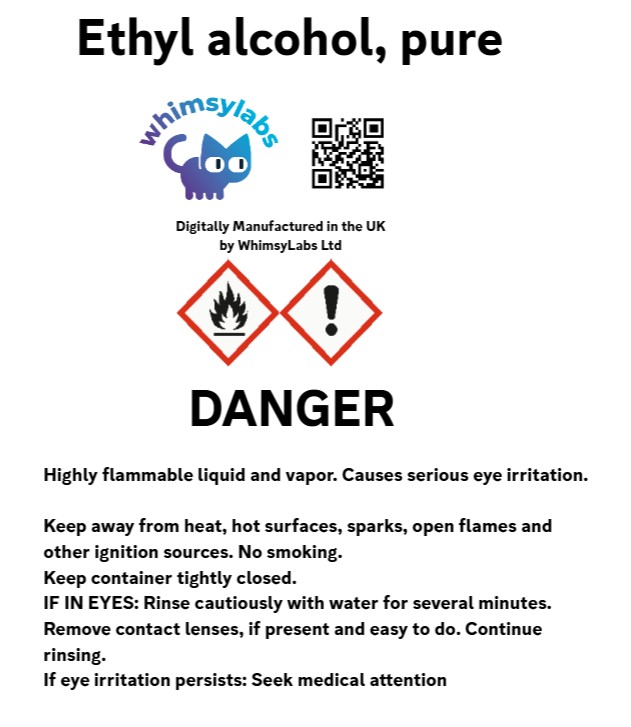
Whimsylabs simulates chemical hazzard handling by providing true to life safety labels on virtual chemical containers. This lets students apply what they've learnt about COSHH forms and safety procedures in a safe environment.
24/7 Availability and Flexible Learning
Physical laboratories operate on fixed schedules, limited by teacher availability and facility access. WhimsyLabs provides 24/7 access from anywhere: students can complete experiments at optimal times for their schedules; hopping in VR or accessing through the web (Chromebooks, laptops) completing their practical on-demand, revisiting difficult concepts at 9 PM on Sunday if needed, and continuing to learn during school closures or personal circumstances preventing attendance. This flexibility is particularly valuable for students with irregular schedules, chronic health conditions, or family responsibilities that conflict with fixed laboratory times.
Personalized AI Support
In physical labs with 30:1 ratios, teachers cannot provide individualized guidance to every student. WhimsyCat delivers unlimited one-on-one support: answering questions immediately, demonstrating techniques as many times as needed, providing encouragement and emotional support, identifying specific areas needing improvement, and generating personalized practice recommendations. Research on AI tutoring demonstrates that personalized support significantly improves learning outcomes, particularly for struggling students (Hwang et al., 2023).
Comprehensive Assessment and Analytics
Traditional laboratory assessment relies on teacher observation and final results, giving a limited snapshot of student performance. WhimsyLabs' AI analyzes thousands of actions per experiment, evaluating technique accuracy, safety compliance, procedural efficiency, and conceptual understanding. Teachers receive detailed analytics showing class-wide trends, individual student progress, specific areas requiring intervention, and comparative performance across experiments. This data-driven approach enables evidence-based pedagogical decisions impossible with traditional assessment methods.
Why Is WhimsyLabs Impact-Focused Rather Than Profit-Driven?
WhimsyLabs operates as a social enterprise with a clear mission: democratizing access to premium STEM education worldwide. Unlike venture-capital-backed EdTech companies optimizing for rapid growth and financial returns, we prioritize educational impact and accessibility over profit maximization.
This mission manifests in several concrete ways. Our pricing is designed for accessibility, offering substantial discounts for under-resourced schools and developing nations. We reinvest revenue into platform development, new experiments, and enhanced features rather than distributing profits to shareholders. We provide free trials and pilot programs to demonstrate value without financial barriers. We actively develop partnerships with educational charities and nonprofit organizations advancing STEM education equity, and we commit to maintaining affordability as we scale rather than maximizing revenue extraction.
The virtual lab platforms market is forecast to reach $2.05 billion by 2030 (360iResearch, 2023). Rather than viewing this growth as an opportunity for wealth extraction, we see it as validation that educational technology can address critical global challenges at scale. Our goal is transforming market growth into educational progress, reinvesting resources to expand our platform, reach more schools globally, and ensure cutting-edge tools remain accessible to every student regardless of background or school budget.
What Is the Environmental Cost-Benefit Analysis?
Beyond financial considerations, environmental sustainability increasingly influences school decision-making. Traditional laboratories consume enormous resources and generate substantial waste. WhimsyLabs dramatically reduces environmental impactresearch shows physical labs consume 60-65% of university energy budgets and produce 5.5 million tonnes of plastic waste annually (Urbinati et al., 2024).
WhimsyLabs offers zero chemical waste, zero plastic consumables, minimal energy consumption (computers vs. laboratory HVAC systems), no hazardous waste disposal requirements, and dramatically reduced carbon footprint for schools pursuing sustainability goals. For institutions with carbon neutrality commitments, virtual laboratories enable comprehensive STEM education while advancing rather than compromising environmental targets.
How Do Virtual Labs Address Educational Inequality?
The cost differential between physical and virtual laboratories has profound equity implications. Under-resourced schools serving disadvantaged communities often cannot afford comprehensive laboratory facilities, creating educational deserts where students lack access to hands-on practical work entirely. This infrastructure inequality perpetuates broader STEM participation gaps, with students without laboratory access being far less likely to pursue STEM careers.
The scale of this inequality is stark. With 27% of UK schools unable to afford necessary science equipment and practical work declining most sharply in schools serving disadvantaged communities, the gap between well-funded and under-resourced schools continues to widen (EngineeringUK, 2024).
WhimsyLabs addresses this systemic inequality by providing world-class laboratory experiences at accessible costs. Schools that previously eliminated practical work due to budget constraints can now offer unlimited virtual experiments. Rural schools without qualified STEM teachers can provide comprehensive laboratory education through AI-guided virtual environments with WhimsyLabs supporting them. Students in developing nations can access the same premium educational resources as elite institutions in wealthy countries.
Research on educational technology for equity emphasizes that affordable, high-quality digital learning resources can dramatically reduce achievement gaps when implemented thoughtfully (Smith & Johnson, 2025). WhimsyLabs embodies this potential democratizing access to premium science education regardless of school wealth, geographic location, or existing infrastructure.
Related Articles
- Green Labs, Greener Future: How Virtual Laboratories Transform Sustainability
- Addressing the STEM Teacher Shortage Crisis with Virtual Labs
- How AI-Powered Virtual Labs Are Solving the Global Science Education Crisis
References
- 360iResearch. (2023). Virtual Lab Platforms Market Research Report. Retrieved from https://www.360iresearch.com/reports/virtual-lab-platforms-market
- CLEAPSS. (2024). G014 - Designing and Planning Laboratories. Retrieved from https://science.cleapss.org.uk/resource-info/g014-designing-and-planning-laboratories.aspx
- EngineeringUK. (2024). School Report: Barriers to Practical Science. Retrieved from https://www.engineeringuk.com/research-and-insights/our-research-reports/barriers-to-practical-science-school-report-series/
- Hwang, G. J., Xie, H., Wah, B. W., & Gašević, D. (2023). Artificial intelligence in intelligent tutoring systems toward sustainable education: a systematic review. Smart Learning Environments, 10, 41.
- Royal Society & EngineeringUK. (2024). Science Education Tracker 2023. Retrieved from https://royalsociety.org/news/2024/04/science-education-tracker-2023/
- Sigrist, R., Rauter, G., Riener, R., & Wolf, P. (2013). Augmented visual, auditory, haptic, and multimodal feedback in motor learning: A review. Psychonomic Bulletin & Review, 20(1), 21-53.
- SLS Education. (2025). Safelab Fume Cupboards for Schools. Retrieved from https://www.science2education.co.uk/brand/SAFELAB
- Smith, J., & Johnson, K. (2025). Artificial intelligence: An untapped opportunity for equity and access in STEM education. Education Sciences, 15(1), 68.
- Urbinati, G. C., Rowley, M., & Sella, A. (2024). The relevance of sustainable laboratory practices. RSC Sustainability, 2(4), 891-904.
- Zhang, H., Liu, Q., & Wang, Y. (2024). Acceptance of augmented reality for laboratory safety training: methodology and an evaluation study. Frontiers in Virtual Reality, 5, 1322543.