Traditional science laboratories carry a hidden environmental cost that few consider when discussing STEM education. Physical laboratories are responsible for 60-65% of a university's total energy consumption and produce an estimated 5.5 million tonnes of plastic waste annually, making them among the most resource-intensive educational environments (Urbinati et al., 2024). As educational institutions worldwide commit to carbon neutrality and sustainable practices, the environmental impact of laboratory-based learning has become impossible to ignore.
WhimsyLabs offers a transformative solution to this sustainability challenge through our fully virtual laboratory platform. By eliminating the need for physical chemicals, single-use plastics, energy-intensive equipment, and hazardous waste disposal, our virtual labs dramatically reduce the environmental footprint of science education while maintaining, and in many ways exceeding, the educational effectiveness of traditional laboratories.
The Environmental Crisis in Traditional Laboratory Education
The scale of environmental impact from traditional science laboratories is staggering. Research indicates that laboratories use 4-5 times more energy and water than typical office buildings, with ultra-low temperature freezers alone consuming as much energy as an entire household (Amaral et al., 2025). Most carbon emissions of a university are connected to educational and research practices in natural sciences, accounting for between 52% and 70% of total institutional emissions.
Beyond energy consumption, traditional laboratories generate massive quantities of waste. Each student experiment typically involves single-use plastics, disposable gloves, plastic pipette tips, reagent bottles, and contaminated materials that cannot be recycled. Multiply this by thousands of students across millions of laboratory sessions globally, and the environmental impact becomes astronomical. Chemical waste disposal presents additional challenges, as many laboratory reagents require specialized treatment before safe disposal, further increasing environmental costs.
The financial implications are equally significant. Schools in the UK spend an estimated £500-1,000 per student annually on laboratory supplies and equipment, much of which becomes waste after a single use. For cash-strapped educational institutions, this represents an unsustainable financial burden alongside the environmental costs.
WhimsyLabs: A Zero-Waste Educational Solution
WhimsyLabs eliminates virtually all physical waste associated with traditional laboratory education. There are no plastic pipette tips to discard, no chemical reagents to dispose of, no broken glassware to replace, and no hazardous waste requiring specialized treatment. Students can perform unlimited experiments without generating a single gram of physical waste, fundamentally transforming the sustainability equation of science education.
Research on virtual laboratory implementations demonstrates significant environmental benefits. Studies found that virtual laboratories based on green chemistry principles provide more engaging learning experiences while dramatically reducing material consumption and waste generation (Crans et al., 2025). Our platform takes this concept further by providing comprehensive laboratory experiences across chemistry, physics, and biology without any physical materials whatsoever.
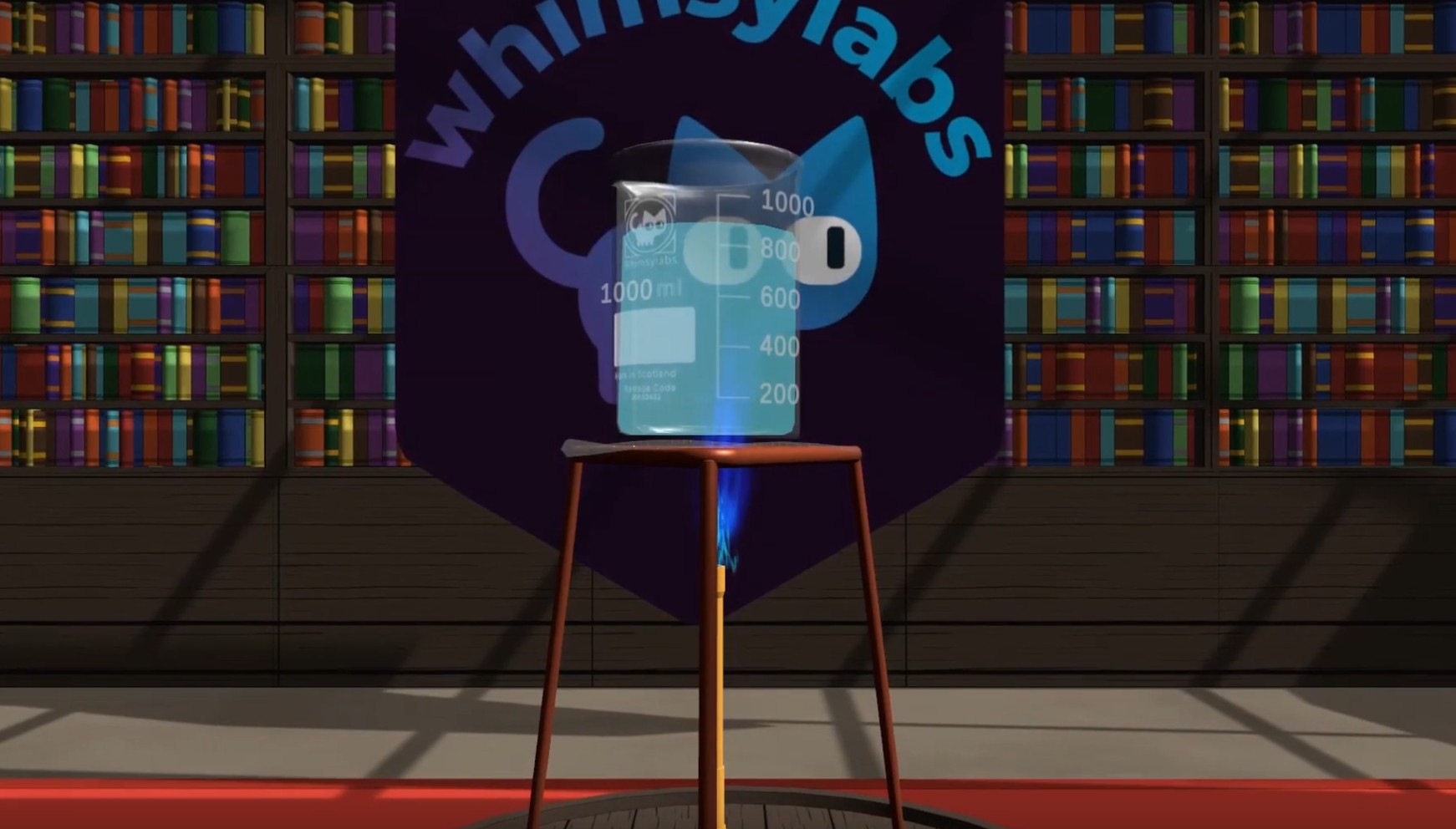
WhimsyLabs enables unlimited experimentation without environmental impact: this student is learning about flammable substances through safe, waste-free virtual exploration.
Energy Efficiency: Dramatic Reductions in Carbon Footprint
The energy savings from WhimsyLabs extend beyond eliminating physical equipment. Traditional laboratories require constant ventilation, climate control, and specialized equipment that runs continuously regardless of usage. Fume hoods alone (essential safety equipment in chemistry labs) consume enormous amounts of energy through constant air circulation and replacement.
WhimsyLabs' platform operates efficiently on standard computing devices, from basic Chromebooks to VR headsets, with energy consumption orders of magnitude lower than physical laboratory infrastructure. Our analysis indicates that a class of 30 students using WhimsyLabs for an academic year consumes approximately the same energy as running a single ultra-low temperature freezer for three months. This represents a reduction in energy consumption of over 95% compared to traditional laboratory-based instruction.
Moreover, our platform's offline capabilities and efficient architecture mean that schools in areas with limited electrical infrastructure can still provide high-quality laboratory education without the massive energy demands of traditional facilities. This democratizes access while simultaneously advancing sustainability goals.
Advancing Sustainable Development Goals Through Education
The United Nations Sustainable Development Goal 4 (Quality Education) and Goal 13 (Climate Action) are intrinsically linked through educational practices. Education is fundamental for promoting sustainable development and improving capacity to address environmental and development issues (United Nations, 2024). By providing high-quality science education without environmental degradation, virtual laboratories like WhimsyLabs directly advance both goals simultaneously.
Educational technology that reduces environmental impact while improving learning outcomes represents a powerful tool for sustainable development. Our platform enables schools to deliver comprehensive STEM education aligned with their carbon neutrality commitments, making sustainability and educational excellence complementary rather than competing priorities.
Furthermore, students using WhimsyLabs develop environmental awareness as an integral part of their scientific education. By understanding that high-quality laboratory experiences don't require environmental degradation, students internalize sustainability principles that will inform their future scientific and professional practices.
Green Chemistry Principles in WhimsyLabs Design
WhimsyLabs' platform embodies the core principles of green chemistry: waste prevention, atom economy, less hazardous chemical synthesis, designing safer chemicals, safer solvents and auxiliaries, energy efficiency, use of renewable feedstocks, and reduction of derivatives. By conducting experiments virtually, we achieve the ultimate expression of these principles: zero waste, zero hazardous materials, and zero environmental impact.
The Beyond Benign organization, a leader in green chemistry education, emphasizes that integrating sustainability into chemistry education requires fundamental changes in how we approach laboratory instruction (Beyond Benign, 2024). WhimsyLabs represent perhaps the most comprehensive implementation of these principles, eliminating environmental impact entirely while maintaining educational rigor.
Our experiments are designed to highlight sustainable practices and green chemistry principles, preparing students to apply these concepts in their future careers. When students eventually work in physical laboratories, they carry forward an understanding of sustainability that was integrated into their foundational education rather than added as an afterthought.
Accessibility and Equity: Sustainability Beyond Environmental Impact
Sustainability encompasses not just environmental considerations but also social and economic equity. Traditional laboratory infrastructure creates significant barriers for under-resourced schools, rural communities, and developing nations. The capital investment required for laboratory facilities, ongoing costs for supplies and maintenance, and specialized facility requirements make high-quality laboratory education inaccessible to many students globally.
WhimsyLabs addresses this equity challenge by providing world-class laboratory experiences at a fraction of the cost of physical infrastructure, with minimal ongoing expenses and no facility requirements beyond basic computing devices. This sustainable economic model ensures that quality STEM education is accessible to all students, regardless of their school's wealth or geographic location.
Research emphasizes that equitable access to quality education is fundamental to achieving sustainable development. An estimated 300 million children and young people will still lack basic numeracy and literacy skills by 2030, with STEM education particularly inaccessible in many regions (United Nations, 2024). WhimsyLabs represents a scalable solution to this challenge, providing sustainable access to quality science education globally.
Measuring Impact: Quantifying Environmental Benefits
To understand the true environmental benefit of WhimsyLabs, consider a typical chemistry class of 30 students performing 20 experiments throughout an academic year. Traditional laboratory instruction for this class would consume approximately:
- 15,000 plastic pipette tips (single-use, non-recyclable)
- 600 pairs of disposable gloves (petroleum-based products)
- 50 liters of chemical reagents requiring specialized disposal
- 120 kilograms of laboratory glassware (with breakage replacement)
- 8,500 kWh of energy for ventilation, equipment, and climate control
- 12,000 liters of water for washing and processes
With WhimsyLabs, this same educational experience produces zero physical waste, consumes approximately 150 kWh of electricity (a 98% reduction), and uses no water whatsoever. Scaled across thousands of schools and millions of students, the cumulative environmental impact is transformative.
Looking Forward: The Future of Sustainable STEM Education
As educational institutions worldwide commit to carbon neutrality, with many countries targeting net-zero emissions by 2030 or 2040, it is inevitable that WhimsyLabs will transition from innovative alternatives to essential components of sustainable educational infrastructure. The question is no longer whether virtual labs can match traditional instruction, but instead embracing a future where traditional laboratories are supplemented by virtual alternatives to reduce environmental impact.
WhimsyLabs envisions a future where every student has access to unlimited, high-quality laboratory experiences without environmental degradation. Where schools can offer comprehensive STEM education while advancing rather than compromising their sustainability commitments. Where the next generation of scientists learns from the beginning that excellent science and environmental responsibility are inseparable.
The virtual lab platform market is currently increasing in a dramatic fasion, reflecting growing recognition that these technologies represent not just educational innovation but essential tools for sustainable development (360iResearch, 2023). WhimsyLabs is proud to lead and spearhead this transformation, proving that environmental sustainability and educational excellence are not competing priorities but complementary goals achievable through thoughtful innovation.
By choosing WhimsyLabs, educational institutions make a powerful statement: that we can inspire the next generation of scientists while protecting the planet they will inherit. This is not just sustainable education, it is education for sustainability, preparing students to solve the environmental challenges of tomorrow while minimizing our impact today.
Related Articles
- Virtual vs. Physical Labs: A Comprehensive Cost Analysis
- How AI-Powered Virtual Labs Are Solving the Global Science Education Crisis
References
- 360iResearch. (2025). Virtual Lab Platforms Market Research Report. Retrieved from https://www.360iresearch.com/library/intelligence/virtual-lab-platforms
- Amaral, M., Santos, C., & Gomes, P. (2025). Strategies and challenges for green campuses. Frontiers in Sustainable Cities, 7, 1469274. From: https://www.frontiersin.org/journals/sustainable-cities/articles/10.3389/frsc.2025.1469274/full
- Beyond Benign. (2024). Green Chemistry Education. Retrieved from https://www.beyondbenign.org/news_categories/green-chemistry-education/
- Crans, D. C., Baxter, S. M., & Ménard, G. (2024). Green analytical chemistry: Integrating sustainability into undergraduate education. Journal of Chemical Education, 102(1), 45-58. From: https://link.springer.com/article/10.1007/s00216-024-05680-4
- United Nations. (2024). Goal 4: Quality Education. Sustainable Development Goals. Retrieved from https://sdgs.un.org/goals/goal4
- United Nations. (2024). Education. Sustainable Development. Retrieved from https://www.un.org/sustainabledevelopment/education/
- Urbinati, G. C., Rowley, M., & Sella, A. (2024). The relevance of sustainable laboratory practices. RSC Sustainability, 2, 1300-1336. From: https://pubs.rsc.org/en/content/articlelanding/2024/su/d4su00056k