There's a concerning narrative in EdTech right now. New platforms promise to "revolutionise" education by automating what teachers do. AI will write your lessons. AI will grade your students. AI will personalise learning. The unspoken message is that teachers are the bottleneck, and technology is the solution.
We think that's backwards.
Teachers aren't the problem to be solved. They're professionals who understand their students, their curriculum, and their classroom in ways no algorithm can match. Educational research consistently shows that teacher quality is the single most important in-school factor affecting student achievement (Opper, 2019). What teachers often lack isn't intelligence or creativity. It's time, resources, and the right tools.
That's why we built WhimsyLabs the way we did. We provide a library of handcrafted virtual experiments ready to use out of the box, AND we give teachers the tools to create exactly what their students need.
Ready-Made Labs for Every Curriculum
Not every teacher wants to build their own experiments, and that's perfectly fine. WhimsyLabs comes with a comprehensive library of pre-built virtual practicals, each designed by science educators and aligned to major exam boards including AQA, OCR, Edexcel, and international curricula.
These aren't basic simulations. Each experiment runs on our physics-accurate engine, so students experience realistic equipment behaviour, proper technique requirements, and genuine scientific outcomes. Research shows that physics-based simulations significantly improve conceptual understanding compared to simplified animations (Finkelstein et al., 2010). You can assign them as-is, confident that students are getting a quality practical experience.
The Problem with Only Pre-Packaged Experiments
Ready-made labs cover the core curriculum well. But teachers tell us they sometimes need something different:
- A specific context. You want to teach titration using examples relevant to your local water supply, not a generic acid-base scenario.
- Extra scaffolding. Your Year 10s need more support than the standard version provides.
- Extended challenge. Your gifted students finished early and need something harder.
- A unique practical. You've designed a brilliant experiment that doesn't exist in any textbook.
Studies on teacher autonomy consistently find that when teachers have control over instructional decisions, both job satisfaction and student outcomes improve (Pearson & Moomaw, 2005). Sometimes you need the flexibility to do things your way.
The Custom Experiment Designer
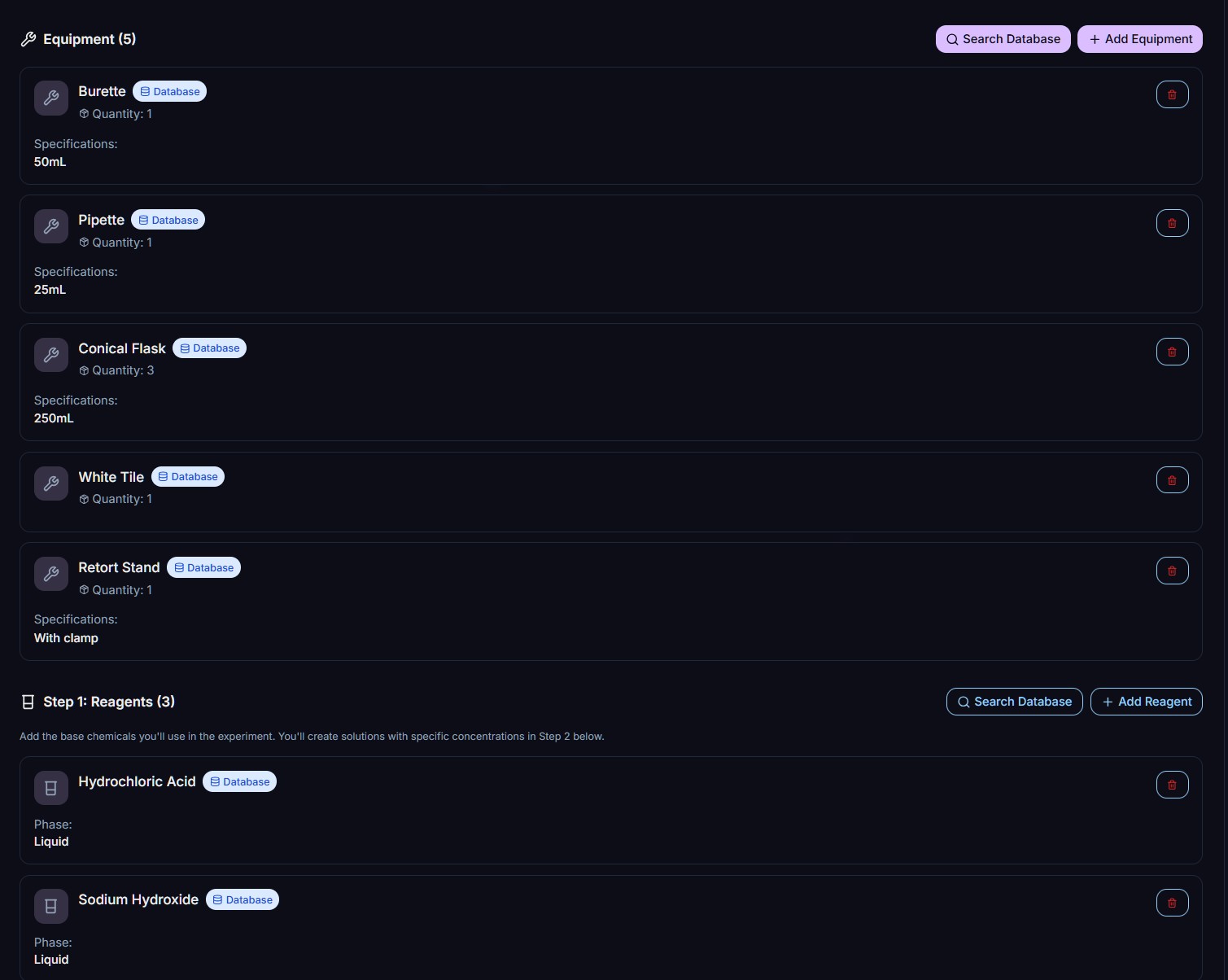
This is where our experiment designer comes in. The process is straightforward: paste in your existing lab protocol, or simply provide a list of equipment and learning objectives. Our AI generates the rest.
You get a complete virtual experiment with:
- Theory and background section introducing the science
- Step-by-step lab guide walking students through the practical
- Assessment questions testing understanding
Here's the key: you can edit any of these. Accept what the AI generates, tweak the parts that don't quite fit your teaching style, or rewrite sections entirely. The AI handles the heavy lifting; you make the pedagogical decisions.
The physics engine does the rest. Whatever equipment and reagents you specify, the virtual lab simulates them accurately. Students get realistic measurements, proper technique feedback, and the authentic feel of lab work.
Why Teacher Control Matters
Research on effective teaching consistently emphasises the importance of pedagogical content knowledge, the specialised understanding that teachers develop about how to teach specific topics to specific students (Ball et al., 2008). When teachers can adapt their tools to their context, good things happen:
- Lessons connect to what came before. You can design an experiment that builds on last week's topic, using the same terminology you've been developing.
- You can respond to your students. If half the class struggled with a concept, you can create a targeted practical to address it that day, not next term when a vendor releases an update.
- Assessment aligns with teaching. The questions you ask can match exactly what you taught, not what someone in a product team decided was "typical."
- You stay the expert. Technology supports your professional judgement instead of overriding it.
Teachers consistently tell us they want more customisation options in their EdTech tools. We're building what teachers actually ask for.
AI as Assistant, Not Replacement
We do use AI in WhimsyLabs. Our AI tutor, WhimsyCat, watches what students do in the virtual lab and offers guidance when they're stuck. Our grading system uses AI to assess practical technique, not just final answers.
But here's the difference: the AI works for you, not instead of you. Research on AI in education emphasises the importance of keeping teachers in the loop for pedagogical decisions (Holstein et al., 2019).
- You set what it teaches. WhimsyCat follows the learning objectives you defined.
- You review its feedback. AI-generated grades are suggestions. You have full override.
- You decide when it intervenes. Want students to struggle productively before getting hints? You can set that.
- It handles the tedious parts. Watching thirty students' titration technique is exhausting. AI can flag the ones who need your attention.
Think of it like a teaching assistant who never gets tired, never misses a step, but always defers to your judgement. That's the role technology should play.
What This Looks Like in Practice
Here's a real example. A chemistry teacher we work with teaches in a school where many students have English as a second language. The standard titration experiment assumes students understand terms like "endpoint" and "burette reading" without support.
Using our experiment designer, she:
- Pasted in her existing paper-based lab protocol
- Reviewed the AI-generated content and simplified the language
- Added visual glossary popups for key vocabulary
- Created scaffolded checkpoints ("Before you add more acid, check: is the solution still pink?")
- Wrote assessment questions using simplified language
The core experiment is the same. The learning experience is transformed. Her students now consistently outperform in practical assessments, not because of better technology, but because she could adapt the technology to their needs. This aligns with research showing that scaffolding is particularly effective for English language learners in science education (Lee et al., 2013).
Choose Your Level of Involvement
To be clear: you can use WhimsyLabs without ever touching the experiment designer. Our ready-made library covers the full science curriculum, and many teachers are perfectly happy using those.
But if you want more control, the tools are there. Whether you tweak one question in an existing experiment or build something entirely new, we support both approaches. The goal is flexibility, not complexity.
Sharing What Works
When teachers create effective experiments, that knowledge shouldn't stay locked in one classroom. WhimsyLabs includes a sharing system where teachers can publish their custom experiments to a community library.
You can browse experiments created by other teachers, see what worked for them, and adapt those designs for your own context. Research on teacher professional learning communities shows that sharing pedagogical resources improves outcomes across schools (Vescio et al., 2008). It's not about replacing your expertise with someone else's. It's about building on each other's work the way professionals in any field do.
The Future of EdTech Should Amplify Teachers
We're not naive. We know why some EdTech companies push the "AI replaces teachers" narrative. It's easier to sell automation than to support human expertise. It's cheaper to build one-size-fits-all than to enable customisation.
But education isn't a factory process. Learning happens between people. Technology can make those interactions richer, remove friction, save time, provide data. What it can't do is replace the human understanding that great teaching requires.
So we built WhimsyLabs on a different premise: teachers are the experts at teaching. We're just experts at building virtual laboratories. When we stay in our lane and give you control, students get the best of both.
If you're a teacher who wants virtual labs that work the way you do, we'd love to show you what that looks like. Get in touch and we'll set up a demo.
References
- Ball, D. L., Thames, M. H., & Phelps, G. (2008). Content knowledge for teaching: What makes it special? Journal of Teacher Education, 59(5), 389-407. https://doi.org/10.1177/0022487108324554
- Finkelstein, N. D., Adams, W. K., Keller, C. J., Kohl, P. B., Perkins, K. K., Podolefsky, N. S., & Reid, S. (2010). When learning about the real world is better done virtually: A study of substituting computer simulations for laboratory equipment. Physical Review Special Topics - Physics Education Research, 6(1), 020108. https://doi.org/10.1103/PhysRevSTPER.6.020108
- Holstein, K., McLaren, B. M., & Aleven, V. (2019). Co-Designing a Real-Time Classroom Orchestration Tool to Support Teacher-AI Complementarity. Journal of Learning Analytics, 6(2), 27-52. https://doi.org/10.18608/jla.2019.62.3
- Lee, O., Quinn, H., & Valdes, G. (2013). Science and language for English language learners in relation to Next Generation Science Standards and with implications for Common Core State Standards for English language arts and mathematics. Educational Researcher, 42(4), 223-233. https://doi.org/10.3102/0013189x13480524
- Opper, I. M. (2019). Teachers Matter: Understanding Teachers' Impact on Student Achievement. RAND Corporation. https://www.rand.org/pubs/research_reports/RR4312.html
- Pearson, L. C., & Moomaw, W. (2005). The relationship between teacher autonomy and stress, work satisfaction, empowerment, and professionalism. Educational Research Quarterly, 29(1), 37-53. https://doi.org/10.1016/j.tate.2015.02.003
- Vescio, V., Ross, D., & Adams, A. (2008). A review of research on the impact of professional learning communities on teaching practice and student learning. Teaching and Teacher Education, 24(1), 80-91. https://doi.org/10.1016/j.tate.2007.01.004