The UK faces a catastrophic STEM teacher shortage, with only 50% of the 26,360 secondary trainees needed recruited in 2022/23, while physics recruitment hit just 17.3% of targets (UK Parliament Education Committee, 2024). This crisis extends globally, with 48 countries reporting STEM teacher shortages and approximately 30% of teachers leaving within their first five years (Adams et al., 2025). WhimsyLabs, based in Edinburgh, UK, but serving schools worldwide, offers a transformative solution through AI-powered virtual laboratories that provide 24/7 intelligent tutoring and automated assessment, dramatically reducing teacher workload while improving learning outcomes.
What Is Causing the STEM Teacher Shortage Crisis?
The scale of the crisis is staggering. In the UK, specialist teacher vacancies in computing and mathematics have more than tripled since 2010, while science vacancies increased sixfold. Between 2020 and 2022 alone, vacancies more than doubled from 1,098 to 2,334, with one in four secondary schools reporting vacant or temporary positions (Roar News, 2024).
The shortage stems from multiple interconnected factors. Approximately 50% of teachers planning to leave the profession in 2024/25 cited high levels of stress and exhaustion as their primary reason. Laboratory-based subjects face additional burdens: managing dangerous chemicals, maintaining expensive equipment, supervising complex practical work, and providing individualized feedback on technique all while managing classroom ratios that often exceed 30:1. Research indicates that STEM teachers report significantly higher workload stress compared to other subjects, with laboratory preparation and grading consuming an average of 3.5 additional hours per week (Institute for Employment Studies, 2024).
Globally, the situation is similarly dire. The United States faces 411,500 vacant or uncertified teaching positions, with 45 states reporting shortages in science and 40 in mathematics. Teacher production has dropped from approximately 31,000 per year a decade ago to around 20,000 currently (Beyond100K, 2025). The impact is most severe in high-need and rural areas, creating educational deserts where students have minimal access to qualified STEM instruction.
How Do Virtual Labs Reduce Teacher Workload?
WhimsyLabs addresses the teacher shortage crisis not by replacing teachers, but by amplifying their effectiveness through intelligent automation of time-consuming tasks while providing students with unprecedented access to personalized support. Our platform tackles the workload crisis through three primary mechanisms:
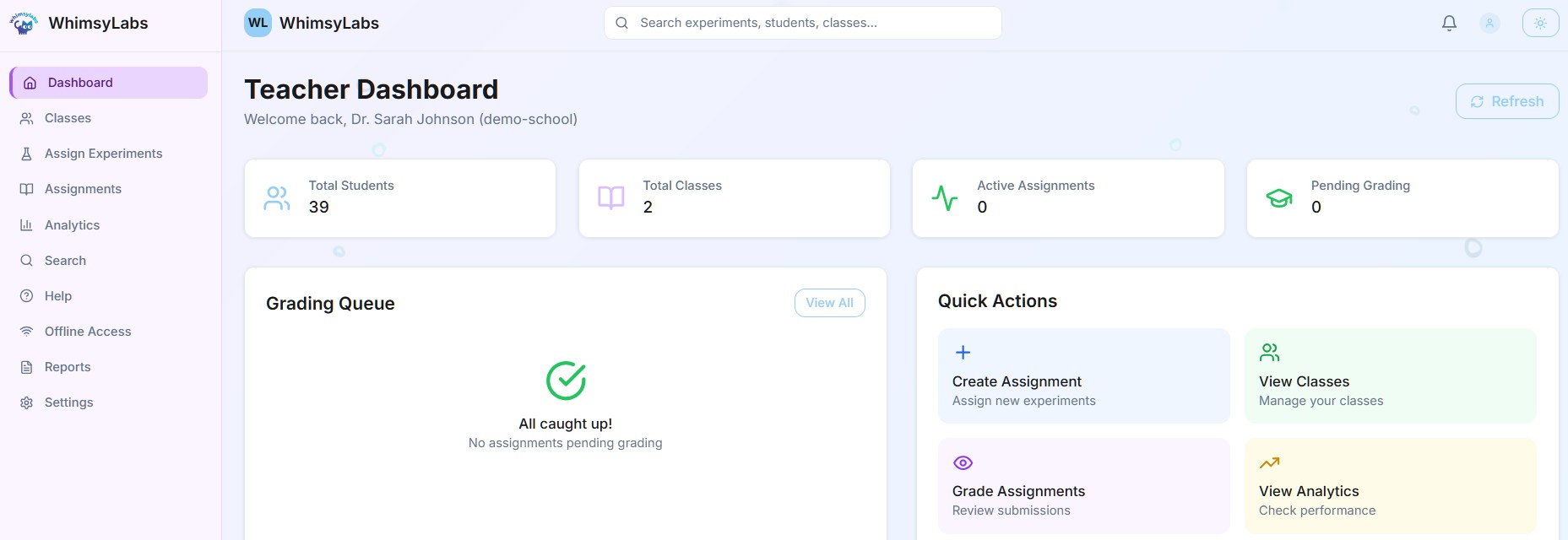
The front page of the WhimsyLabs teacher dashboard, showing class overview, student progress, and assessment metrics. The dashboard is designed to be intuitive and easy to use, with a clean and modern interface, and is available in both light and dark mode.
Automated Intelligent Assessment
Laboratory assessment is notoriously time-intensive, requiring teachers to evaluate not just final results but also procedural technique, safety compliance, and analytical reasoning. WhimsyLabs' AI assessment system analyzes thousands of student actions per experiment, providing detailed, personalized feedback that would typically require one-on-one observation.
Our system reduces grading time by an estimated 3.5 hours per week per teacher while simultaneously providing more comprehensive feedback than humanly possible to deliver at scale. Research on AI-enabled assessment demonstrates that intelligent tutoring systems can match or exceed human grading accuracy while providing immediate feedback that enhances learning outcomes (Zhang et al., 2025).
Teachers retain full control through our comprehensive dashboard, which shows student actions, AI-generated assessments, and provides easy override capabilities. This human-in-the-loop approach ensures educational decisions remain in the hands of qualified educators while dramatically reducing their administrative burden.
24/7 AI Tutoring Support
With classroom ratios exceeding 30:1 in most UK schools, teachers can spend only 2-3 minutes per student per lesson, creating a critical personalization gap. WhimsyCat, our AI tutor, provides unlimited one-on-one support, answering questions, providing hints, and guiding students through complex procedures at any time, from anywhere.
Unlike basic chatbots, WhimsyCat monitors student behavior in real-time, proactively identifying struggling students through behavioral pattern analysis and intervening with targeted guidance before minor issues become major obstacles. Studies show that proactive AI engagement in education allows for earlier intervention and more personalized support, significantly improving learning outcomes compared to traditional query-based systems (Zawacki-Richter & Lohmann, 2023).
In addition, we have taken notes from some of the most successful tutorialisation models in games, with one example drawn from how Link looks at objects you can interact with in The Legend of Zelda: The Wind Waker. WhimsyCat uses similar visual cues to draw student attention to relevant apparatus or chemicals, reducing cognitive load and helping students focus on critical aspects of the experiment without constant teacher supervision.
This 24/7 accessibility is particularly crucial for addressing educational inequality. Students who miss school due to illness, have limited teacher access in underfunded schools, or require additional support outside classroom hours can continue learning without falling behind. The AI tutor never tires, never loses patience, and can simultaneously support unlimited students, something impossible with human teachers alone. This leaves the teacher free to focus on high-value tasks that require human judgment and empathy.
Zero Laboratory Preparation and Maintenance
Physical laboratories require extensive preparation: ordering chemicals, setting up equipment, creating safety protocols, and post-experiment cleanup. Teachers report spending 1-2 hours on lab preparation for every hour of instruction. WhimsyLabs eliminates this entirely: teachers simply assign experiments through our platform, and students can begin immediately without any physical setup, safety concerns, or cleanup requirements.
This time savings is particularly significant for schools struggling with teacher shortages. A single qualified teacher can now effectively support multiple classes through well-designed virtual laboratory assignments supplemented by AI tutoring, extending their impact far beyond what traditional laboratory instruction allows.
Why Is This Approach More Effective Than Traditional Alternatives?
Unlike video demonstrations or static simulations that simply present information, WhimsyLabs provides authentic learning experiences where students physically perform procedures, make real mistakes, and develop genuine laboratory skills. Our approach combines the benefits of hands-on laboratory work with the scalability and personalization of digital technology.
Research in virtual reality motor skill learning demonstrates that virtual practice can effectively transfer to real-world performance when the virtual environment maintains high levels of physical fidelity and provides accurate feedback on technique (Levac et al., 2019). Students using WhimsyLabs develop procedural competency, muscle memory, and conceptual understanding that transfers directly to physical laboratories; all without requiring scarce teacher time for one-on-one supervision.
For schools facing teacher shortages, this means students no longer have reduced practical work or eliminated laboratory experiences. Instead, they gain unlimited access to high-quality, supervised (by AI) practical education that develops authentic skills while freeing teachers to focus on high-value pedagogical activities like curriculum design, individual student mentorship, and addressing complex conceptual difficulties.
What Impact Does This Have on Global Education?
Globally, our platform addresses critical access inequalities. Rural schools without qualified STEM teachers can provide world-class laboratory education through our platform. Under-resourced schools that cannot afford extensive laboratory equipment can offer unlimited practical experiences at a fraction of traditional costs. Students in countries facing severe teacher shortages can access personalized instruction that would otherwise be completely unavailable.
The World Economic Forum identifies collaborative problem-solving skills and leadership as critical for career success in STEM fields, ranking among the top growing skills essential for future employment (World Economic Forum, 2025). WhimsyLabs develops these skills through sandbox-style experiments where students design procedures, troubleshoot unexpected results, and collaborate on complex challenges. This approach fosters authentic scientific practice that teacher shortages often prevent in traditional settings.
How Does WhimsyLabs Support Rather Than Replace Teachers?
A critical distinction of our approach is that we enhance rather than replace teacher expertise. WhimsyLabs handles routine tasks: grading, basic tutoring and laboratory setup, freeing teachers to do what they do best: inspire curiosity, guide complex thinking, provide emotional support, and build meaningful relationships with students.
Our comprehensive teacher dashboard provides unprecedented insights into individual and class performance, highlighting specific areas where teacher intervention would be most valuable. This allows educators to strategically allocate their limited time to maximum effect, focusing on students who need human judgment, encouragement, or advanced guidance that AI cannot provide.
For trainee teachers, WhimsyLabs reduces the overwhelming workload that drives 30% to leave within five years. By automating time-consuming assessment and providing AI support for routine questions, we make teaching more sustainable and rewarding, potentially improving retention rates and making STEM teaching careers more attractive to new entrants.
What Does the Future Hold for Teacher-Technology Partnerships?
The STEM teacher shortage will not resolve quickly through traditional recruitment alone. Teaching remains one of the most demanding professions, with teachers facing a burnout rate experiencing burnout (Teacher Magazine, 2019). With "Retention is linked to teachers’ sense of being effective." (Mayer et. al 2015). Our platform addresses this crisis by making teaching more sustainable and more effective while providing students with experiences that would otherwise be impossible.
WhimsyLabs envisions a future where every student has access to unlimited, high-quality laboratory experiences regardless of their school's teacher availability or resources. Where teachers are empowered rather than overwhelmed, freed from administrative drudgery to focus on the deeply human aspects of education that truly require qualified professionals. Where geographical location, school funding, or teacher shortages no longer determine whether students can pursue STEM careers.
Based in Edinburgh, we are committed to democratizing access to premium science education technology for all institutions, addressing the global crisis in STEM education through thoughtful integration of AI and virtual reality. Our mission is not to replace the irreplaceable human connection at the heart of great teaching, but to amplify its reach and effectiveness in an era of unprecedented challenges.
The teacher shortage crisis demands bold, innovative solutions. WhimsyLabs offers a proven approach that makes teaching more sustainable, learning more accessible, and STEM education more effective for students worldwide. By combining cutting-edge technology with sound pedagogical principles, we are helping to ensure that every student, regardless of their circumstances, can develop the scientific skills and knowledge to succeed in an increasingly technological world.
Related Articles
- Meet WhimsyCat: AI Support for Overwhelmed Teachers
- 24/7 AI Tutoring: Reducing Teacher Workload While Improving Outcomes
- Virtual vs. Physical Labs: Making STEM Education Sustainable
- How AI-Powered Virtual Labs Are Solving the Global Science Education Crisis
References
- Adams, J. D., Gupta, P., & DeFelice, A. (2025). A systematic review of STEM teacher recruitment and retention interventions. International Journal of STEM Education, 12(1), 4.
- Beyond100K. (2025). 2025 Beyond100K Trends Report: Trends and Predictions That Are Defining STEM in 2025. Retrieved from https://beyond100k.org/2025-beyond100k-trends-report/
- Institute for Employment Studies. (2024). Why is the recruitment and retainment of teachers so challenging? Retrieved from https://www.employment-studies.co.uk/news/why-recruitment-and-retainment-teachers-so-challenging
- Levac, D. E., Huber, M. E., & Sternad, D. (2019). Learning and transfer of complex motor skills in virtual reality: a perspective review. Journal of NeuroEngineering and Rehabilitation, 16, 121.
- Roar News. (2024). STEM Teacher Shortage in the UK. Retrieved from https://roarnews.co.uk/2024/stem-teacher-shortage-in-the-uk/
- UK Parliament Education Committee. (2024). Education Committee publishes report on teacher recruitment, training and retention. Retrieved from https://committees.parliament.uk/committee/203/education-committee/news/201461/education-committee-publishes-report-on-teacher-recruitment-training-and-retention/
- World Economic Forum. (2025). The Future of Jobs Report 2025. World Economic Forum.
- Zawacki-Richter, O., & Lohmann, S. (2023). Proactive and reactive engagement of artificial intelligence methods for education: a review. Frontiers in Artificial Intelligence, 6, 1151391.
- Zhang, Q., Wang, L., & Yang, T. (2025). Adaptive intelligent tutoring systems for STEM education: Analysis of the learning impact and effectiveness of personalized feedback. Smart Learning Environments, 12(1), 5.