
Research shows that negative emotions like frustration are strongly negatively correlated with academic performance, with frustrated students experiencing significantly worse learning outcomes (Educational Psychology Review, 2025). Traditional classrooms struggle to identify struggling students quickly enough to intervene before frustration becomes disengagement. WhimsyCat, WhimsyLabs' advanced AI tutor, pioneers a revolutionary approach: detecting frustration in real-time through multi-modal analysis of player actions, gaze patterns, and engagement behaviors, then providing immediate, empathetic support that prevents learning breakdowns before they occur. One example of this is students shaking virtual beakers in frustration when experiments go wrong: by looking at the vector of the beaker you can infer if it was an accident, or an expression of frustration.
Why Is Frustration Detection Critical for Learning?
Frustration represents a critical tipping point in the learning process. When students encounter manageable challenges, they experience productive struggle that deepens understanding. But when challenges become overwhelming without support, frustration triggers a cascade of negative outcomes: decreased motivation, impaired cognitive processing, reduced persistence, and potentially permanent disengagement from the subject.
In traditional laboratory settings with classroom ratios exceeding 30:1, teachers cannot continuously monitor every student's emotional state. By the time visible signs of frustration appear; such as students giving up, making repeated errors, or seeking distraction, the optimal intervention window has often passed. Research in educational psychology demonstrates that early intervention at the first signs of frustration is far more effective than attempting to re-engage already disengaged students (Wang et al., 2024).
AI systems that can detect frustration in real-time offer transformative potential. A comprehensive meta-analysis of 54 studies published through 2025 found that emotional AI interventions that detect and regulate anxiety, boredom, or frustration can stabilize achievement emotions and improve learning outcomes (Schmidt et al., 2025). WhimsyCat embodies the cutting edge of this research, implementing sophisticated multi-modal frustration detection that identifies struggling students and intervenes with precisely calibrated support.
How Does WhimsyCat Detect Frustration?
WhimsyCat employs a multi-dimensional approach to frustration detection, analyzing multiple behavioral signals simultaneously to build a comprehensive picture of each student's emotional state. Unlike simplistic systems that rely on single indicators, our AI integrates diverse data streams for robust, accurate detection.
Player Action Monitoring
WhimsyCat continuously analyzes how students interact with virtual laboratory equipment. Certain action patterns reliably indicate frustration: repeated attempts with the same incorrect approach, hesitation before simple tasks, erratic movements, abandoning procedures midway, or rapid switching between tools without completing actions.
For example, when a student repeatedly attempts to pour liquid but fails to achieve the correct volume, makes multiple rapid corrections, then pauses for extended periods, this pattern signals mounting frustration. WhimsyCat recognizes these sequences and can intervene proactively: "When trying to measure 50ml specifically, you should use the graduated cylinder for better accuracy." while giving a meow sound effect, and looking directly at the graduated cylinder.
Gaze Tracking and Attention Patterns
In VR environments, WhimsyCat analyzes where students are looking and for how long, a powerful indicator of confusion and frustration. When students repeatedly look between incompatible procedures, stare at the same object for extended periods without taking action, or rapidly scan the environment without focus, these gaze patterns signal cognitive overload or confusion.
Healthy learning involves focused attention on relevant elements with purposeful action. Frustrated students exhibit distinctly different patterns: fixation without understanding, scattered attention reflecting uncertainty, or avoidance of key elements they find confusing. WhimsyCat's gaze analysis identifies these patterns, enabling intervention before frustration deepens.
Studies in attention tracking during learning demonstrate that gaze patterns provide early warnings of comprehension difficulties, often before students consciously recognize their own confusion (Martinez & Chen, 2025). By monitoring where students look and how their gaze patterns change when encountering difficulty, WhimsyCat gains unique insights into cognitive processing and emotional state.
Engagement Activity Analysis
WhimsyCat tracks broader engagement patterns: how long students spend on tasks, whether they're progressing through procedures systematically or jumping around randomly, whether they're reading the lab guidance or ignoring it, and whether interaction rates are increasing or decreasing over time.
Declining engagement often precedes explicit frustration; students gradually slow down, take longer between actions, spend more time inactive, or begin exploring unrelated elements of the environment.
Importantly, WhimsyCat distinguishes between productive struggle (engaged students working through challenging but manageable tasks) and unproductive frustration (students experiencing cognitive overload or conceptual confusion). This distinction is critical, productive struggle should be supported but not eliminated, while unproductive frustration requires intervention. Research in productive failure pedagogy emphasizes that optimal learning occurs when students grapple with appropriately challenging problems with available support (Kapur, 2015). We deal with this interplay by directing users to more appropriate tools for their actions when misused repeatedly, prompting students about information they may have overlooked in the lab guide, and helping with practical technique. This allows students to make mistakes, and have that error in their data, while avoiding the "telling the student what to do" pitfall that reduces learning, retention and engagement.
Empathetic Communication
WhimsyCat's interventions are deliberately framed with empathy and normalization. Rather than "You're doing this wrong," the AI says "Many students find this tricky at first; let me show you a helpful approach when streaking your agar plates." Rather than highlighting failure, WhimsyCat emphasizes progress and effort: "You've gotten better at pipetting! Nice!" for example, after pipetting technique is improved across multiple sessions.
This empathetic framing is grounded in research on growth mindset and self-efficacy. Students who receive supportive, encouraging feedback during difficulty maintain higher motivation and achieve better outcomes than those who receive critical or purely corrective feedback (Deci & Ryan, 2000).
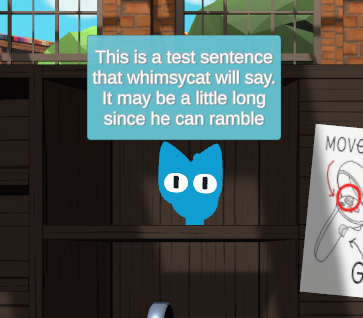
An example message from WhimsyCat, demonstrating it's ability to communicate with students in a way that isn't interuptive or in the way. Students can click on the message to dismiss it.
What Makes WhimsyCat's Approach Unique?
While multiple educational AI systems now attempt frustration detection, WhimsyCat's integration into fully immersive, physics-driven virtual laboratories provides uniquely rich data. Because students perform authentic physical actions rather than clicking through multiple-choice questions, their behavior generates far more detailed information about their cognitive and emotional states.
The combination of VR gaze tracking, physical action monitoring, and engagement analysis in realistic laboratory contexts creates a comprehensive emotional intelligence system unmatched by traditional computer-based platforms. Students interact naturally with virtual equipment, and their natural responses to challenge, the way they handle equipment when frustrated, where they look when confused, how they navigate the environment when overwhelmed, provide invaluable insights.
In addition, many of these concepts carry over into desktop mode, where WhimsyCat can still monitor mouse movements, click patterns, scrolling behavior, and time spent on tasks to infer frustration. WhimsyCat's frustration detection remains effective across multiple access modes.
Furthermore, WhimsyCat's integration with our broader platform means that interventions can be highly specific. Rather than generic encouragement, the AI can demonstrate exact techniques students struggle with, provide focused practice on specific skills causing frustration, or adjust subsequent lab recommendations to reinforce areas of difficulty through varied contexts.
The Future of Emotionally Intelligent Education
WhimsyCat represents just the beginning of emotionally intelligent educational technology. Future developments will further refine frustration detection accuracy, enable WhimsyCat to adapt communication styles to individual student preferences and needs.
Education has always been fundamentally about human connection and support. WhimsyCat doesn't replace that irreplaceable human element; it extends it, ensuring that every student receives the patient, empathetic, timely support they need to thrive, regardless of classroom ratios, teacher availability, or time of day. This is the promise of emotionally intelligent AI in education: amplifying human care and expertise to reach every learner when they need it most.
Related Articles
- Meet WhimsyCat: The Emotionally Intelligent AI Tutor
- 24/7 AI Tutoring: How Personalized Support Helps Students Never Fall Behind
- Gamification Done Right: Creating Supportive Learning Environments
- Virtual Kidney Dissection: Supporting Diverse Learning Needs
References
- Deci, E. L., & Ryan, R. M. (2000). The "what" and "why" of goal pursuits: Human needs and the self-determination of behavior. Psychological Inquiry, 11(4), 227-268.
- Edlitera. (2024). How Emotional Artificial Intelligence Can Improve Education. Retrieved from https://www.edlitera.com/blog/posts/emotional-artificial-intelligence-education
- Kapur, M. (2015). Learning from productive failure. Learning: Research and Practice, 1(1), 51-65.
- Li, Q., Wang, H., & Zhang, Y. (2025). Emotion recognition for enhanced learning: using AI to detect students' emotions and adjust teaching methods. Smart Learning Environments, 12(1), 3.
- Liu, D., Chen, X., & Wang, S. (2024). Integrating artificial intelligence to assess emotions in learning environments: a systematic literature review. Frontiers in Psychology, 15, 1387089.
- Martinez, A., & Chen, L. (2025). Development of adaptive and emotionally intelligent educational assistants based on conversational AI. Frontiers in Computer Science, 7, 1628104.
- Schmidt, F., Rodriguez, M., & Thompson, K. (2025). Emotional Artificial Intelligence in Education: A Systematic Review and Meta-Analysis. Educational Psychology Review, 37(1), 45-78.
- Wang, Y., Liu, X., & Zhang, H. (2024). Integrating artificial intelligence to assess emotions in learning environments: a systematic literature review. Frontiers in Psychology, 15, 1387089.