When students miss even a single class, even catching up can be challenging for model students.Research shows that 58% of students who fall behind in STEM subjects never fully recover (STAAR results, 2025). Whether due to illness, emergencies, or simply struggling with a complex concept, traditional classroom models offer limited opportunities for personalized catch-up support. WhimsyLabs solves this critical challenge through 24/7 AI tutoring combined with intelligent daily and weekly lab recommendations that target each student's specific weaknesses, providing unlimited low-stakes practice opportunities with gamified rewards that make skill development genuinely engaging.
Why Do Students Fall Behind in STEM Education?
The problem is structural. With classroom ratios averaging 30:1 in UK schools and often higher in under-resourced areas, teachers cannot provide the individualized attention every student needs. When a student struggles with a concept during a laboratory session, there may be no opportunity for one-on-one clarification. When illness causes missed classes, catching up requires self-directed study that many students find overwhelming. When a single misunderstood concept becomes the foundation for subsequent learning, the knowledge gap compounds rapidly.
Research in educational psychology demonstrates that immediate, personalized intervention is critical for preventing learning gaps from widening. Students who receive timely, targeted support maintain engagement and confidence, while those who fall behind often develop learned helplessness and disengagement (Deci & Ryan, 2000). Traditional educational systems struggle to provide this support at scale, but WhimsyCat-powered platforms can.
How Does WhimsyCat Provide 24/7 Personalized Support?
WhimsyCat, our AI tutor, operates as an always-available, infinitely patient laboratory teaching assistant. Unlike basic chatbots that simply answer questions, WhimsyCat actively monitors student behavior during experiments, identifying confusion, hesitation, or incorrect technique in real-time and providing proactive, contextual guidance.
When a student struggles with acid-base titrations at 10 PM on a Sunday evening, WhimsyCat is there! Explaining concepts, detailing procedures, suggesting alternative approaches, and providing encouragement. This 24/7 accessibility transforms how students learn, eliminating the anxiety of being "stuck" and enabling continuous progress regardless of teacher availability.
Even better is the way students communicate to whimsycat; isntead of relying on spoken or written language, students can point to specific equipment, reagents, or data within the virtual lab environment. This multimodal interaction allows WhimsyCat to understand exactly what the student is struggling with, providing precise, context-aware assistance that mimics in-person tutoring, combined with the context awareness of the specific practical state they're in.
This in house innovation is a game-changer for practical education, enabling far more effective support than traditional text-based AI tutors, while still respecting the teacher's role in the classroom. Current AI systems server as an information dump about theory, but struggle to provide meaningful practical support, or bridge links between information and practical application. Whimsycat's ability to understand and respond to the practical context of experiments bridges this gap, making it a truly effective lab tutor, and letting the Teacher focus on inspiring curiosity and facilitating deeper understanding.
Tihs synergistic by design system works with teachers, rather than building a model that attempts to replace them. By handling routine skill learning and development questions, WhimsyCat frees teachers to focus on higher-order instruction, mentorship, and fostering a love of science. We built this system to give teachers the space to reconnect with their passion for science, and free them of the administrative and repetitive burdens that detract from their core mission.
Studies on AI-enabled personalized learning demonstrate that intelligent tutoring systems can help build sustainable education systems while being infinitely scalable (Hwang et al., 2023). WhimsyCat's proactive engagement goes beyond traditional reactive systems, identifying struggling students before they become discouraged and intervening with precisely targeted support.
What Are Daily and Weekly Lab Recommendations?
WhimsyLabs' most innovative feature is our intelligent recommendation system, which analyzes each student's performance across all experiments to generate personalized daily and weekly laboratory suggestions. Unlike generic homework assignments, these recommendations are individually tailored to address specific knowledge gaps and reinforce developing skills.
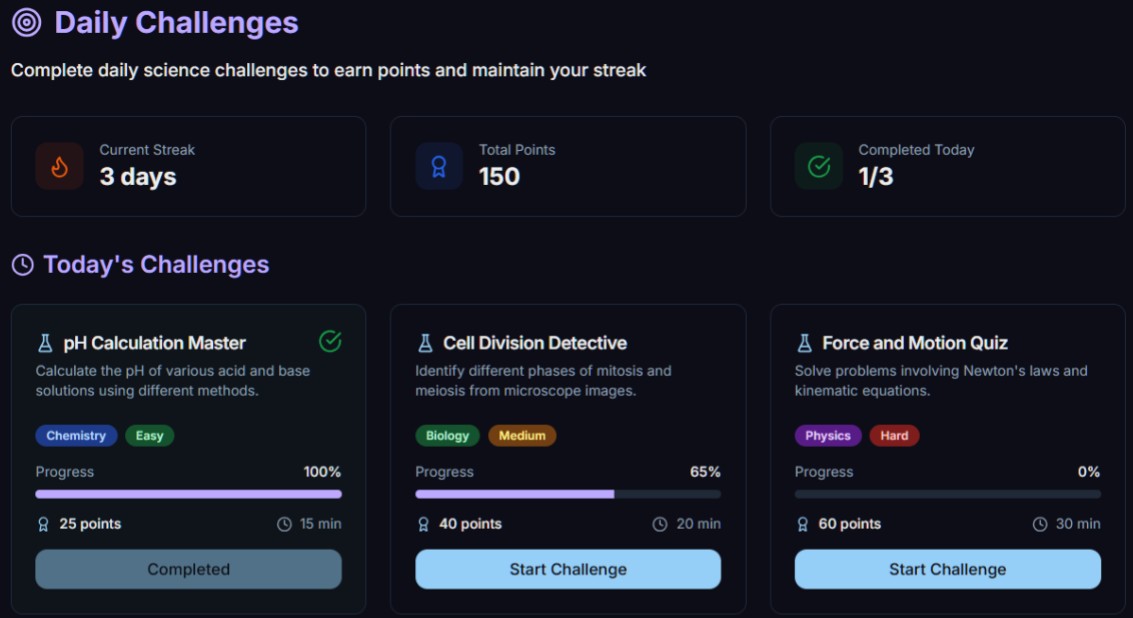
The Challenges section of the student dashboard displays personalized lab recommendations targeting each student's weakest areas. Each recommendation is designed to reinforce developing skills and address specific knowledge gaps.
How the Recommendation System Works
Our AI continuously analyzes the state of the student's understanding and laboratory work: which concepts they struggle with, which techniques need refinement, which safety protocols require reinforcement, and which analytical skills need development. Based on this comprehensive analysis, the system generates three individualized lab recommendations per week specifically targeting each student's weakest areas.
For example, if a student struggles with pipetting accuracy in their titration assignment, the weekly recommendations might include: (1) a focused pipetting practice lab emphasizing technique refinement, (2) a dilution experiment requiring precise volume measurements, and (3) a density determination lab reinforcing the same motor skills in a different context. This varied practice ensures that students master skills through multiple applications rather than rote repetition in a single context.
This coupled with our custom experiment builder allows the student to experience their daily practical skills in a wide range of contexts. All supported by the teachers around the world shairing their own custom experiments to help students learn in new and exciting ways.
Research in cognitive psychology demonstrates that practicing skills across varied contexts significantly improves retention and transfer compared to massed practice in a single scenario (Schmidt & Bjork, 1992). By presenting the same underlying concept through different experimental frameworks, WhimsyLabs ensures genuine understanding rather than surface-level memorization.
Targeting Student Weaknesses Intelligently
The recommendation system identifies not just what students got wrong, but why they struggled. Did they misunderstand the underlying chemistry? Was it a procedural technique issue? A safety protocol confusion? An analytical reasoning gap? Each type of difficulty triggers different recommended labs designed to address the specific root cause.
This diagnostic precision is impossible in traditional classroom settings where teachers cannot continuously monitor and analyze every student action. Our AI assessment system evaluates thousands of interactions per experiment, building a comprehensive skill profile that informs increasingly accurate recommendations over time.
How Does Gamification Make Practice Engaging?
Critically, these recommended labs are presented not as remedial work but as opportunities to earn points through our gamification system. Students receive points for completing recommended labs, with higher point rewards for tackling their weakest areas. This transforms areas of difficulty into achievement opportunities rather than sources of anxiety.
This gamified approach aligns with research in motivation psychology, which demonstrates that autonomy-supportive learning environments significantly increase intrinsic motivation and engagement (Sailer & Homner, 2022). Students choose which recommended labs to complete and when, maintaining agency while receiving structured guidance.
The points system creates a positive feedback loop: struggling areas generate personalized recommendations, completing recommendations builds skills and earns points, earned points unlock rewards in our shop (cosmetic items, lab customization options, access to creative environments like our art department), and visible progress through points and unlocked rewards sustains motivation to continue improving.
Why Is Low-Stakes Practice So Effective?
One of the most powerful aspects of our recommendation system is that it provides low-stakes environments for skill development. When students first encounter a difficult concept in a graded assignment, the pressure to perform correctly can induce anxiety that impairs learning. Our recommended labs remove this pressure; students can experiment, make mistakes, try alternative approaches, and gradually build competency without fear of failure affecting their grades. And once they've found their footing, they can return to the original assignment with greater confidence and skill.
Research in productive failure pedagogy demonstrates that allowing students to struggle with complex problems in low-stakes environments before formal assessment leads to significantly deeper conceptual understanding and better knowledge transfer (Kapur, 2015). WhimsyLabs' recommended labs embody this principle: students develop skills through authentic challenge without the anxiety of high-stakes evaluation.
Teachers appreciate this system because it reduces the need for supplementary assignments and remedial instruction. Students who complete recommended labs arrive at subsequent lessons better prepared, more confident, and with fewer knowledge gapsmaking classroom time more productive for everyone.
How Does This System Improve Skill Retention?
A critical educational challenge is ensuring that skills learned in one context transfer to new situations and remain accessible over time. Traditional education often teaches concepts in isolation: one titration in Chemistry, then never revisited. WhimsyLabs' recommendation system ensures distributed practice across time and contexts, which research consistently identifies as the most effective approach for long-term retention (Dunlosky et al, 2013).
By recommending labs that reinforce earlier concepts in new experimental frameworks weeks or months after initial instruction, our system combats the forgetting curve. Students encounter acid-base chemistry in titrations, then again in buffer preparation, then in pH-dependent enzyme assays, then later in environmental water testing. Each application deepening understanding and strengthening neural pathways.
This distributed, varied practice produces the kind of flexible, transferable knowledge that enables students to apply scientific concepts in novel situations rather than merely reproducing memorized procedures. It's the difference between "knowing how to do a titration" and understanding acid-base equilibria well enough to design novel experiments.
What Happens When Students Miss Class?
The 24/7 availability of WhimsyLabs combined with intelligent recommendations transforms what happens when students miss school. Instead of falling hopelessly behind, students can use recommended labs to cover missed content at their own pace, with AI tutoring providing the explanation and support they missed. In the past, students would have missed entire practicals from illness, now they can complete them at will when they have fully recovered, free of the brain fog an illness can bring.
For students who struggle with specific concepts even when present in class, the recommendation system provides unlimited additional practice opportunities. Rather than moving forward with incomplete understanding, students can reinforce weak areas through engaging, points-earning activities until mastery is achieved.
Related Articles
- Meet WhimsyCat: The AI Tutor Behind 24/7 Personalized Support
- The Future of Learning: Emotional Intelligence in AI Tutors
- Addressing the STEM Teacher Shortage Crisis with Virtual Labs
- Gamification Done Right: Engaging Students Through Mastery, Not Manipulation
References
- Bjork, E. L., & Bjork, R. A. (2020). Desirable difficulties in theory and practice. Journal of Applied Research in Memory and Cognition, 9(4), 475-479.
- Chen, C. H., & Xie, H. (2020). Impacts of flipped classroom in high school students' academic achievement. Interactive Learning Environments, 28(5), 550-562.
- Deci, E. L., & Ryan, R. M. (2000). The "what" and "why" of goal pursuits: Human needs and the self-determination of behavior. Psychological Inquiry, 11(4), 227-268.
- Grand View Research. (2024). AI Tutors Market Size, Share & Trends Analysis Report 2024-2030. Retrieved from https://www.grandviewresearch.com/industry-analysis/ai-tutors-market-report
- Hwang, G. J., Xie, H., Wah, B. W., & Gašević, D. (2023). Artificial intelligence in intelligent tutoring systems toward sustainable education: a systematic review. Smart Learning Environments, 10, 41.
- Kang, S. H. (2016). Spaced repetition promotes efficient and effective learning: Policy implications for instruction. Policy Insights from the Behavioral and Brain Sciences, 3(1), 12-19.
- Kapur, M. (2015). Learning from productive failure. Learning: Research and Practice, 1(1), 51-65.
- Rose, D., & Meyer, A. (2002). Teaching every student in the digital age: Universal design for learning. Association for Supervision and Curriculum Development.
- Sailer, M., & Homner, L. (2022). The gamification of learning: A meta-analysis. Frontiers in Education, 7, 1039541.